Politicos on both the left and the right have traditionally assumed that middle-class Asian-Americans boast a status akin to whiteness.
While right-wing billionaires sue Harvard on the grounds that affirmative-action programs for disadvantaged minorities discriminate against both asians and whites, many left-wing publications ignore asian-americans altogether when discussing issues of racial justice. Those that do frequently note the diversity of the "AAPI" (Asian-American Pacific Islander) community, separating "privileged" middle-class demographics, like Chinese-, Japanese- and Indian-Americans from working-class Filipino- and Vietnamese-Americans.
However, although middle-class East Asians tend to enjoy incomes comparable to or higher than the white majority, they experience subtle but pernicious discrimination in the social and cultural spheres of American life.
Asian-Americans of all stripes are under-represented in film, cable and broadcast TV, comprising as few as 3 percent of film roles and 2.5 percent of cable Television roles in 2016. Those Asians that do manifest on the Silver Screen tend to be shown as either crafty foreigners, sexually-incompetent dweebs or a combination of both (look no further than the Hangover's Mr. Chow).
Asian-American youth are the demographic most likely to be bullied in school. Asian-American adults are the least likely to be promoted to corporate management positions (despite being over-represented in the professional fields). And Asian-American males are the least-likely to "match" with a partner on both gay- and straight- dating websites.
The last fact hits particularly close to home. I have spent days at a time on Tinder "swiping" right (on profiles of all races) without getting a single match. The infrequency with which I match on Tinder or Bumble heightens the stakes for each match I do get, so that my anxiety acts up when I finally land a date. My lack of success in online dating, has caused tremendous personal frustration in the last 5 years.
All of these forms of racism speak to an enduring typecast of Asian-Americans as effeminate foreigners, who are good at math but poor at people-skills, leadership, decisiveness and other traits that define the heterosexual "man's-man". While stereotypes about African-Americans and Jews (though still pervasive) must at least be coded for utterance in polite society, jokes about Asian's "tiny dongs" and accounting skills get a pass in the (ostensibly-) most progressive corners of America.
Despite embracing an attitude of #resistance to the Trump presidency, many progressives have showed ignorance or indifference to the revelation of Harvard's racist "personality" rankings of Asian-Americans (which admittedly came about as part of a lawsuit that had a reactionary agenda, but still...). The Democratic Party's minority outreach efforts ahead of the 2018 midterm election focused primarily on Latino voters, despite the fact that Asian-Americans are a principal demographic in the suburban swing districts crucial to Democrats' success. To date, I can find no example of a progressive policy focused explicitly on the concerns of the Asian-American community.
Indeed, rather than confront Trump's racially-coded China-bashing, the Democratic party's most liberal politicians have-in many instances-piled on. Even if the protectionist tarriffs Democrats propose are primarily economic in focus, they lend credence to an agenda that is as much about nationalism as about restoring trade deficits.
Although Trump has (with a couple exceptions) avoided overt racial animus towards Asians until now, his record on race indicates that he is more than capable of stirring up anti-Chinese, if not anti-Asian sentiment, say, if a crisis erupts with a China or if his poll numbers falter.
Can progressives be counted on to defend the rights of Asian-Americans, as participants in the American social contract rather than as foreigners deserving mere "respect", when the time arises?
I would hope so. But the evidence so far suggests otherwise.
Sunday, March 17, 2019

Sunday, March 3, 2019
Bojack Horseman Review
I finally caught up with the Bojack Horseman craze last night when I watched the first episode of season 1 (courtesy of my free Netflix subscription, that's right!). I had heard many positive reviews from friends and other acquaintances, so I began watching with eager eyes. The episode began in an uneven fashion but held out hope at the end for a more promising trajectory.
At first glance, Bojack Horseman comes across as Family Guy 2.0, updated for 2010s hipster sensibility. There's the loutish, alcoholic middle-aged slacker (in this case, a celebrity horse, who had a TV show in the 90s). There are anthropomorphic animals (of course, more of them and more central to the plot). And there are the ubiquitous flashbacks to events that explain a particular reference or suit his/her whimsy.
The subtext is more serious, however. Bojack needs to get his novel out to fulfill terms of indenture (a flailing penguin publishers--run by actual penguins). Lacking self-discipline, he can't. HIs part-time girlfriend/agent breaks up with him, after a contentious date.
The animals, the sex/drugs and the level drama almost make it feel like one giant effort at irony. Look guys (my imaginary studio exec would say): its Charlie Sheen he's a horse (almost in "War Horse"), he barfs cotton candy and has a publishing contract. Won't that crack up the youngster's in Williamsburg?
Halfway through, Bojack was trying too hard and not making me laugh.
Fortunately, the repetitiveness of the gags (e.g. the party requests, Peanut Butter crossover jokes) made me a laugh after a little while. Some playful absurdity at work. Nice!
I'll be watching seasons 2 or 3 and getting back afterwards.
Saturday, August 18, 2018
A rant on "real-time" transit scheduling
I'm mad as hell...
at the love of my life
and I'm not going to take this anymore.

My feelings toward...

the love of my life
__________________________Picture this: You break your neck to take the 6:00PM bus from your work in Monterey Park to Downtown LA, to connect to a 6:20 bus that (Google Maps' transit directions say) will get you to your grandparents house right on time for a 7:05 dinner. The first bus arrives a few minutes behind schedule (given by Google Maps), but still gets you to Downtown with 5 minutes to spare. You run up the gently-sloping hill to the stop where you catch the second bus (1 minute). Then you wait 10 minutes: no bus comes.
Its 6:26 now. You take out your smartphone and ping GoogleMaps. From "your location" to my grandparents' address, the app now shows a bus that leaves at 6:38. "You couldn't have missed the 6:20!" your conscience yells. There were two other guys here who say they waited for 5 minutes before (though, did they actually keep track?). Still, its only another 10 minutes, the brain reasons: you take a deep inhale, sigh and return to playing free computer chess.
You lose yourself in plotting some crafty chess moves, eventually taking down a queen and a knight. At some point during the game, you press the home button on your phone by mistake and see that it is 6:50. Suddenly remembering that you are en route to dinner, and not a pawn in a game, you open up Google Maps again. This time, the transit directions instruct you to walk 1 mile to the south to catch a bus that will take 12 minutes longer to deliver you to your grandparents. You are stunned to see that you will not arrive until 8pm. You would miss dinner.
The new calculation throws you into a frenzy. You can order a Lyft Line or Uber Pool and maybe get to your grandparents only 30 minutes late. And yet, you are at a bus stop: what if the bus due at 6:38 miraculously appears a minute after you make your request, which you can't cancel without incurring a $5 penalty. Is a 50 percent or lower chance of saving time worth $11 extra? Your family is more forgiving of delay than, say, your boss, so you continue to wait...
After another 4 minutes, give or take, two buses show up. You board the latter one. Riding in light traffic, the bus drops you off 2 blocks from your grandparent's door at 7:30.
______________________________
I experienced this saga twice last Friday, first on the evening commute from work (as narrated) and later on a trip to the bar (the latter trip did not involve a transfer).
Although the delay was longer than usual, this was not the first time that a Google Maps transit schedule has deceived me. On most of my transit journeys in the Los Angeles region, in fact, Google's transit departure and arrival times seem to follow the official schedules, with buses arriving a few minutes before or after the time given on the application.
Even if such variability does not always cause excessive delay, it forces transit riders to leave extra time for contingencies (e.g. arriving at the bus stop 10 minutes ahead of Google's scheduled times) and diminishes their perceived agency over their trip schedule. By contrast, drivers benefit from real-time traffic information and point-to-point travel. Thus, driving (already privileged by roadway engineering, subsidized infrastructure, etc.) gains even more of an advantage over transit in Los Angeles, and transit riders ditch their straps for steering wheels once they acquire the resources.
Given that automobiles are the greatest source of Greenhouse Gas Emissions in the state of California, transit's inability to offer riders the accurate, real-time information offered to drivers fails not only transit enterprises, but society.
Why does Google Maps' transit planner (the most comprehensive transit planning application in terms of regional and national coverage) fail so miserably at providing accurate schedules for LA-area agencies? Is there a structural flaw in the GTFS specification? Does blame lie with the agencies or with Google (or both?)? I am interested in learning more about this problem and engaging with potential solutions.

Friday, June 29, 2018
I'm back
Now that I've graduated from planning school, I will be writing on a more regular basis.
The last two weeks have been a bit of a whirlwind for me. I graduated and celebrated for a couple days before beginning a full-time job at a planning consulting firm. In the ten days I have worked there as an employee, I have already completed several major assignments. I feel somewhat accomplished for landing a salaried job, and yet it exhausts me. I don't know how people can put up with this rigid schedule for four decades or more. Maybe I'll get used to it. Or maybe, I've been hooked on the gig economy.
Receiving my master's degree felt like less of a milestone than I anticipated. I don't feel as if I have grown too terribly much over the past few years. I have learned a lot in my program but I still hold many of the same beliefs and preferences (and the same bad habits) that I had two years, or even four years ago (when I graduated from college).
One revelation of my professional program and job networking is that people skills (and communication, more generally) matter more than technical skills for the success of one's career. I can't say I have advanced tangibly in this regard but I have become more discerning of my behavior in social settings.
Anyhow, enough of my life and on to the world. I will try to post at least once a week. Keep me to it!
The last two weeks have been a bit of a whirlwind for me. I graduated and celebrated for a couple days before beginning a full-time job at a planning consulting firm. In the ten days I have worked there as an employee, I have already completed several major assignments. I feel somewhat accomplished for landing a salaried job, and yet it exhausts me. I don't know how people can put up with this rigid schedule for four decades or more. Maybe I'll get used to it. Or maybe, I've been hooked on the gig economy.
Receiving my master's degree felt like less of a milestone than I anticipated. I don't feel as if I have grown too terribly much over the past few years. I have learned a lot in my program but I still hold many of the same beliefs and preferences (and the same bad habits) that I had two years, or even four years ago (when I graduated from college).
One revelation of my professional program and job networking is that people skills (and communication, more generally) matter more than technical skills for the success of one's career. I can't say I have advanced tangibly in this regard but I have become more discerning of my behavior in social settings.
Anyhow, enough of my life and on to the world. I will try to post at least once a week. Keep me to it!
Saturday, April 7, 2018
A train trip across California
On Wednesday, I traveled 442 miles across the state of California, from Oakland to Van Nuys (just north of Los Angeles). Lasting 10.5 hours, the trip is the longest single train voyage I have taken in my life. Paralleling the California Coast Line, the trip provided stunning scenery as well as moments of deep reflection.

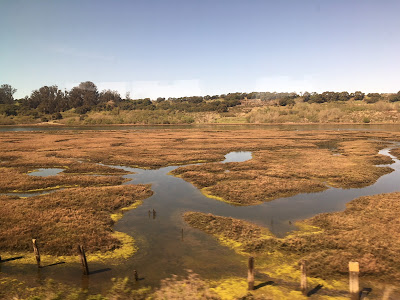
First, the trip provided some amazing vantage points. Near Monterey, the track ran right alongside the Elkhorn Slough salt marsh.

In San Luis Obispo county, the verdant hillside appeared particularly alluring.

The numerous beaches the train passed that lacked a trace of human activity, the hilly pastures teeming with cattle reminded me just how rugged California is beyond the primary urban cores.


Finally, the trip exposed me to the state's underbelly. The derricks of the San Ardo Oil Field (the 8th-largest in the state) had a haunting, monstrous aesthetic, a testament to our society's continued dependency on fossil fuel extraction (even in a "progressive" state).
The California Men's Colony, north of San Luis Obispo, paired authoritarian, rectangular geometry with a suprising openness to the outside world. I could see persons (prisoners?) wandering through the courtyard from the train.

I stepped onto the platform in Van Nuys with sensations of perplexment and awe.
16th-century Spanish conquistadores conceived of California as a physical island. I believe this metaphor to be quite fitting, when taken in the plural: not a singular island but an archipelago.
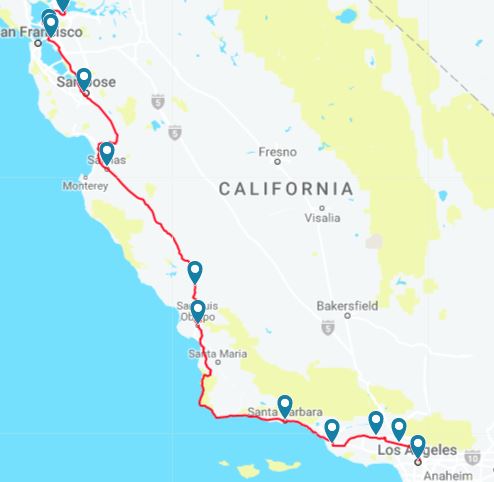
Route of train from the Bay Area to Los Angeles
First, the trip provided some amazing vantage points. Near Monterey, the track ran right alongside the Elkhorn Slough salt marsh.

Elkhorn Slough
Further south, the train hugged the banks of the Salinas River, and later, the Pacific Coastline.
Along the Salinas River, near Bradley California

Beach near Gaviota, about 32 miles west of Santa Barbara
In San Luis Obispo county, the verdant hillside appeared particularly alluring.

The numerous beaches the train passed that lacked a trace of human activity, the hilly pastures teeming with cattle reminded me just how rugged California is beyond the primary urban cores.


Empty Beaches
Finally, the trip exposed me to the state's underbelly. The derricks of the San Ardo Oil Field (the 8th-largest in the state) had a haunting, monstrous aesthetic, a testament to our society's continued dependency on fossil fuel extraction (even in a "progressive" state).
The California Men's Colony, north of San Luis Obispo, paired authoritarian, rectangular geometry with a suprising openness to the outside world. I could see persons (prisoners?) wandering through the courtyard from the train.
San Ardo Oil Field in operation

California Men's Colony
16th-century Spanish conquistadores conceived of California as a physical island. I believe this metaphor to be quite fitting, when taken in the plural: not a singular island but an archipelago.
Saturday, January 21, 2017
Trump the Caudillo and the Latin American-ization of US Politics


Donald Trump's authoritarian, demagogue-like tendencies frequently merit comparison to Hitler and Mussolini. On the morning after Il Orange entered the Oval Office, a search for "fascism" turned up about 285,000 listings on Google News, with the vast majority of results (on the first three pages) pertaining to the Cheato. Unfortunately, the gross, genocidal excesses of both the fascist and Nazi regimes make these comparison a bit ineffective in my opinion (as long as he does not start a World War and commit mass murder of ethnic minorities, Trump will be "okay"). A more effective (and recent) parallel may be drawn to the Caudillos, or populist strongmen, of Latin America.
Often (but not always) emerging from the military, and including leaders as diverse as Augusto Pinochet, Juan Peron and, disputedly, Hugo Chavez, the Caudillo rises to power through brash appeal to the disaffected working classes. Once he takes control (sometimes through military coup but often through popular vote) the Caudillo dilutes or abolishes the legislative checks on his executive power (e.g. amending the constitution to run for additional terms or evicting the press from the Oval Office), without actually upending with the democratic system or its institutions of governance. When the political establishment cries foul, the Caudillo declares that he is "under attack" by the ruling (e.g. beltway) elites, thereby rallying support from disaffected segments of the lower or middle classes.
Furthermore, an essential component of a Caudillo's appeal (particularly for right-leaning ones) is the projection of masculine dominance--the image of the "macho" man who can get things done (and have his way with woman).
What is particularly striking about the comparison of Donald Trump and Latin American strongmen are the similar political contexts which have birthed them. Latin American countries are among the few in the world that share the United State's presidential form of democracy, where the executive branch is chosen independently from the legislative branch. In contrast to the form of parliamentary democracy dominant in Europe, the executive in a presidential republic does not leave office if an opposing gains control of the legislature. And yet, presidential republics naturally subject the executive's law-making authority to the legislature's approval as part of the system of checks-and-balances. Therefore, when the branches of government are divided, especially between ideologically-opposed parties, gridlock is the most likely outcome.
Since the president's derives his legitimacy independently from the legislature, arbitrary executive authority provides a convenient tool to break inaction, one that--unfortunately--subverts the legislative checks crucial to democracy's survival.
For a long time the American President did not need to override Congress because members of both parties could compromise to enact legislation with a broad centrist appeal. The ideological polarization of recent decades has changed this. Presidents Bush and Obama both came to rely on executive mandate. God only knows how Trump might wield his power on immigration policy or trade.
In Latin American countries, by contrast, the legacies of a colonial caste system have long produced sharp division between white criollo landowners and a mixed-race and indigenous laboring class. Thus presidential democracy has been tested from an early age by a combination of class- and race-based polarization (often augmented by geography), which has only afflicted the US political system for the last 50 years.
(Of course, the US political system largely muted racial divisions for much of its history by actively excluding the colored working classes from political participation. My argument is that such polarization did not previously manifest itself in politics, not that it did not previously exist).
With sharp polarization, partisans on one side will believe the worst of the opposing party (even ludicrous mistruths). When their party secures the presidency, they will support any executive initiative to overcome opposition in the legislature (especially by a minority party). If their party controls the legislature (but not the presidency) they will demand obstruction of governance, to the point of a breakdown (or unilateral action).
Such contempt for minority rights (or, alternatively phrased, support for authoritarianism) is especially evident among classes that feel like their position of privilege is threatened.
Will Trump use the slightest threat to declare a state of emergency (with the military by his side)? Will he simply work to perpetuate GOP rule by appointing justices who strike down the remainder of our voting rights protections? Or will he alter libel laws so that he can stifle critical media coverage with lawsuits?
The future is uncertain, terrifyingly so.
Our country is not exceptional (i.e. destined to be a liberally democratic). The historical moment is not normal.
For the next four years, we must never let down our guard.
We must always resist.
Saturday, December 31, 2016
2016: What were you and where am I?
As the New Year approaches, I am at a bit of a loss for words.
Partly, I have been experiencing a bit of burnout the past few weeks after a 10-week quarter in which I wrote more than 50 pages worth of analytical material on planning history and theory and transportation policy.
Even more broadly, 2016 has been an exceptionally surreal year, punctuated by unexpected and cataclysmic events that have been difficult to explain or to minimize out of my daily routine of existence.
The election of Donald Trump, the "Brexit" referendum results, the sabotage of the American election by Russian spies. Just like the string of celebrity deaths in the past week, these events numb one with shock (Listening to Obama's and Hillary's speeches in the back of an Uber on the morning of November 9th came the closest I have felt to living a hallucination).
But since my future career (as a Transportation planning and policy student) entails working with or on behalf of local governments the great "political" events or very much personal. If the Trump administration cuts off federal support for public transportation (and redirects such funding towards private toll roads) or strangles LA's wholesale sector by imposing tariffs, then not only will my job opportunities but the ideals I aspire towards in my career suffer a set back.
Once upon a time, I shunned "Identity Politics" and though that racism did not affect me. I have evolved a great deal since then, but until this November I did not feel as if my personal existence, as an American with Chinese ancestry, was threatened. Watching a middle-aged white male yell at an Asian undergrad to "go back to your own country," in the middle of my campus's Court of Sciences, shattered my blissful contentedness.
Sharing an Uber (back in March, believe it or not!) with a young man who complained about "Islam" and "cuck-servatism". Consoling a teary-eyed stranger in an Uber on election night.
Even watching the cities I had visited in Europe a few years back suffer both jihadi terrorist attacks and far right political rallies sent shivers up me.
For all the catastrophes that have shaped the world around me, however, I have been fortunate to have made good friends a part of my return to school. I have also managed to reconnect with a number of people from my undergrad days and earlier (particularly through the Olive Tree Initiative). It is in times like these that these personal connections matter most.
This is also the year that I first felt "old" in more than a relative sense. A few crazy nights back in February (which resulted in me getting a fever) revealed a liver that lacked its youthful pep. Having lost my uncle and a close friend in the previous year, I have given a lot more thought to my mortality. I officially reached a quarter century in age.
Time does not stand still but it does not necessarily progress or retreat.
That is my story of 2016.
Partly, I have been experiencing a bit of burnout the past few weeks after a 10-week quarter in which I wrote more than 50 pages worth of analytical material on planning history and theory and transportation policy.
Even more broadly, 2016 has been an exceptionally surreal year, punctuated by unexpected and cataclysmic events that have been difficult to explain or to minimize out of my daily routine of existence.
The election of Donald Trump, the "Brexit" referendum results, the sabotage of the American election by Russian spies. Just like the string of celebrity deaths in the past week, these events numb one with shock (Listening to Obama's and Hillary's speeches in the back of an Uber on the morning of November 9th came the closest I have felt to living a hallucination).
But since my future career (as a Transportation planning and policy student) entails working with or on behalf of local governments the great "political" events or very much personal. If the Trump administration cuts off federal support for public transportation (and redirects such funding towards private toll roads) or strangles LA's wholesale sector by imposing tariffs, then not only will my job opportunities but the ideals I aspire towards in my career suffer a set back.
Once upon a time, I shunned "Identity Politics" and though that racism did not affect me. I have evolved a great deal since then, but until this November I did not feel as if my personal existence, as an American with Chinese ancestry, was threatened. Watching a middle-aged white male yell at an Asian undergrad to "go back to your own country," in the middle of my campus's Court of Sciences, shattered my blissful contentedness.
Sharing an Uber (back in March, believe it or not!) with a young man who complained about "Islam" and "cuck-servatism". Consoling a teary-eyed stranger in an Uber on election night.
Even watching the cities I had visited in Europe a few years back suffer both jihadi terrorist attacks and far right political rallies sent shivers up me.
For all the catastrophes that have shaped the world around me, however, I have been fortunate to have made good friends a part of my return to school. I have also managed to reconnect with a number of people from my undergrad days and earlier (particularly through the Olive Tree Initiative). It is in times like these that these personal connections matter most.
This is also the year that I first felt "old" in more than a relative sense. A few crazy nights back in February (which resulted in me getting a fever) revealed a liver that lacked its youthful pep. Having lost my uncle and a close friend in the previous year, I have given a lot more thought to my mortality. I officially reached a quarter century in age.
Time does not stand still but it does not necessarily progress or retreat.
That is my story of 2016.
Subscribe to:
Comments (Atom)