Tuesday, December 31, 2019

2010s alienation

As the start of 2020 approaches, I have been agonizing over a thought piece to write on the 2010s.  While reading through "best of the decade" articles for inspiration, it dawned on me how removed I am from the trends that have defined the past 10 years. The 2010s, a Guardian columnist writes, have been both a "decade of crisis" and alienation, in which the foundations of post-Cold War capitalist society have started to crumble at the very moment western youth become self-absorbed in their social media feeds and self-improvement. Life has become both fast-paced and erratic, predicated on Promethean multi-tasking (and multi-focusing) capabilities. And yet, neither the global upheavals in politics and the environment nor the lifestyle changes brought about by social media have significantly affected me.

First, with regards to crisis: this decade has had its share of catastrophes. I still vividly remember going to the UCLA campus (I was studying for a master's at the time) the morning after Donald Trump's election. The emotions that I then felt, a mixture of sadness, rage and grief-were more powerful than any I had ever experienced outside of a couple family tragedies. I nearly got into a scuffle with a pro-Trump heckler I encountered near the Math Science Building while partaking in an anti-Trump protest march during a break from class.

Protests on the UCLA Campus following Donald Trump's Election, November 10, 2016

I had avoided the news for a few years prior to the 2016 election. My involvement in heated campus political debates as an undergraduate student had left me with an aversion for partisan feuding, despite maintaining strong political beliefs. I went into urban planning partly because I (wrongly) thought it would be a way to implement progressive policies without having to fight political battles. However, the threatening nature of Donald Trump's candidacy combined with the even more unsettling feat of his election victory prompted me to renew my focus.

The balance between staying informed and keeping sane has been tough. I have long struggled with OCD and anxiety. Scanning through provocative online headlines in the first year following the election led to many restless and unproductive afternoons. I have gone so far as to delete Apple News from my phone but still read the Atlantic and New York Times on a weekly basis.

Still, despite my revived news interest, I don't feel a strong sense of personal impact from the events of the past decade. President Trump's racist, classist and isolationist policies and rhetoric have not (yet) personally affected me as a middle-class, straight, Eurasian male. The more volatile climate has led to more wildfire and flooding episodes here in southern California but I have an insulated home with modern, air-conditioning, heating and Netflix. Not being able to go outside for a few hours on a certain fall or winter day is a disappointment, not an inconvenience.

Smoke-filled Vista of West Hollywood during the Bel Air Fire, December 2017

Similarly, I feel out of place with the trend towards constant "multi-tasking." The growing sophistication of smartphones in the last decade, coupled with the emergence of social media platforms like Instagram, has enabled everyone to do everything all at once. Everyone that is, except for me.

I have always been thorough in my processing of information, preferring lengthy travel books and encyclopedias as a young reader to the "For Kids" summaries favored by my peers. For much of the last decade, I strived towards an academic/research career (first in history and then in urban planning), immersing myself ever more deeply into the thorny details of weighty theoretical questions.

 Smartphones

While much of the world moved from traditional news journalism to Buzzfeed, I progressed from occasionally reading the New Yorker to regularly reading articles in the Journal of the American Planning Association. While I sought out the life of the mind, others lived the life of the meme.

This is not to say that I never multi-task or superficially scan social media. When typing a piece on my computer (as I'm doing now), it can be incredibly difficult for me not to open another window in order to scan headlines in the New York Times or London Review of Books. However, I cannot pretend-as most can-that such switches of attention are productive or even momentary. One scan of the page leads me to read one article, click on three links and so on. It is the idea of the millennial as a net-savvy multi-tasker that excludes me.

At the other extreme, the anxiety created by digital multi-tasking and global tumult has made "mindfulness" meditation increasingly popular. "Mindfulness" sessions aim to reduce anxiety by drawing participants' attention to the present moment, through techniques such as deep breathing and listening to statements of self-affirmation.


As someone who periodically participates in mindfulness meditation, I believe it has many therapeutic benefits. Meditation helps me acknowledge the subjectivity of my thoughts and emotions in stressful situations.

And yet, many mindfulness videos and programs I have encountered espouse foolishly optimistic attitudes towards the world and life. For instance, morning meditations I have listened to on Youtube repeat phrases1 like "Today is going to be a great day" or express gratitude2 for such modern "miracles" as "the electric light," "stoves," and "automobiles." The former statement seems out of touch with a society in which many people struggle to pay education or medical bills. The latter papers over the fact that many modern conveniences also contribute to climate change.

Much of the past decade's pop culture mindfulness, which implicitly demands a retreat from the public sphere, amounts to nothing more than escapism. Like boozy brunches and Netflix binges, mass meditation has served only as a momentary distraction from a world on the brink.

For much of the 2010s, I have felt isolated in a world that teeters between chaos and distraction. This isolation has been compounded by my social anxiety and awkwardness. In the last few months, the future has begun to look more promising. I have come to terms with some of my inner demons and began to accept my unique personality.

The next decade will likely be even more tumultuous. Climate change will accelerate. Trump won't go down without a fight, with social media being a prime battleground.

Therefore, I feel compelled to take a stand in the 2020s rather than sitting it out. My recent personal crisis has inspired me to express my ideas and opinions. To provide a digital outlet for deep thinking on an array of topics, communicated in terms anyone can understand.

My first big project for 2020 will be to upgrade and expand this blog (more details coming soon). Its hard to project what will happen afterward. I look forward to the journey.

1. See Today is a Great Day-10 Minute Guided Morning Meditation. https://www.youtube.com/watch?v=nhMinG8RNek
2. See Louise Hay's Morning Meditation. https://www.youtube.com/watch?v=4jNV1FV-_Os&t=9s

Sunday, December 1, 2019

Architectural Aesthetics and Density Politics in Los Angeles

Density is now a hot-button topic in LA politics. The high price of housing in the region has drawn attention to the city’s byzantine land use regulations, which restrict the density and height of multi-family development while burdening new units with requirements to provide off-street parking spaces. While some advocacy groups (looking at you, Abundant Housing LA) support zoning reforms and other housing-friendly policies, they face strong opposition from both local neighborhood associations and prominent politicians.

Some of the opposition can be easily explained in terms of rational self-interest (e.g. a building blocking a view of the Hollywood sign) or generational conflict (Baby Boomers clinging to a mid-century suburban ideal versus city-loving middle-class Millenials). But given the visceral nature of anti-growth sentiment, which at times goes against the self-interest of the parties involved (e.g. homeowners in Westwood opposing high-density commercial developments that would increase the value of their property), I suspect that a larger psychological bias is at play.

A Google search for “ugly development” yields more than 82.5 million results, with seven of the top nine housing-related results specifically criticizing multi-family housing design and two of these being articles criticizing current densification in Santa Monica. As if Google can read the sub-conscious, a related image search which surfaces at the bottom of the page bears the terms “Modern Apartment Buildings.”


 ©Creative Commons (Unsourced Photos taken by Author)


Dingbat (Top), Concrete monster (middle), Concrete monster+ “Hipster Fencing” (bottom)

In an article from several years back, that was cross-published on Zocalo Public Square and the development-skeptic news site CityWatch, architect Greg Goldin denigrates’ Los Angeles’ “public architecture” (I.e. everything excluding the single-family residence) as “resoundingly mediocre.”
Might it be the case that popular animosity towards density in Los Angeles stems at least partly from the low-grade design of its 3+ story buildings?

Having been on an apartment search for the past three months, I have found plenty of supporting evidence. Many of the region’s high-density neighborhoods, such as West Hollywood and Koreatown, are littered with a mix of tacky dingbats (sorry, Dingbat lovers, being regionally- and historically-specific does not compensate for aesthetic deficiencies) and monochrome concrete boxes which look like they’re made out of either fine-grained paper mache or painted-over cardboard. Post-2000 structures usually add on an annoying “hipster fence” and glass façade. I have seldom encountered apartment buildings that either appealed to my aesthetic sensibilities or conveyed a unique sense of place.
_________________________________________________

What might an alternative high-density architecture look like? When I ponder this question, I think back to my mid-June visit to Chicago, arguably the world’s first high-rise city. The “Loop”, as the city’s central business district is referred to, boasts many eye-pleasing skyscrapers including the Chicago Board of Trade and Frank Lloyd Wright's "Rookery" building.

Chicago Board of Trade (Top), The Rookery (Bottom)

Collectively, the high-rise facades make for some impressive skyline views.


  “City Beautiful”. Views of the Chicago Loop looking west from Millenium Park 

While the Loop is a classic Central Business District, with land uses overwhelmingly commercial and tourist-oriented in nature, the brick-and-mortar turn-of-the-century elegance extends well into the inner-ring suburbs, including along this commercial/apartment corridor nearWrigley Field.

Wrigleyville street, spotted from the "L"

_____________________________________________

LA should not mimic Chicago’s architecture as it densifies. Nor does it need to. Hidden amidst central Los Angeles’s boxy behemoths, one can find stunning duplexes, triplexes and even three to five story apartment buildings constructed in the Spanish Colonial Revival and Art Deco styles. Nearly all of these were constructed before World War II.

Spanish Revival Adobe Duplex in Fairfax Neighborhood
Colonial Revival apartment building in Beverly Hills

Two months after visiting Chicago, I flew across the Atlantic to Madrid. While walking off jet lag during my first evening, I stumbled upon the Gran Via, a majestic commercial street that was largely developed during the early twentieth century. 

Gran Via Street Scene

Despite their young age, many of the buildings have adapted the baroque features (e.g. elaborate marble columns and cartouches) that characterize the architecture of Madrid's historic center.


Madrid historic center: Plaza Mayor (top) and Palacio Real (bottom)

The art deco edifice of the Circulo de Bellas Artes (the “Circle of Fine Arts”-i.e. the city's theater/cultural center) particularly caught my attention.

Circulo de Bellas Artes

Standing at eight stories (183 feet) high, it would easily dwarf most LA apartment buildings outside of downtown. And yet, the geometric window/column patterns and graceful upper-story curvature make it attractive rather than imposing. The neo-baroque colonnade and grey color palate cohere nicely with the surrounding low-rise edifices.

The Circulo is a modern skyscraper which pays homage to Madrid’s 18th-century Baroque architecture and helps foster a unique and appealing sense of place on the Gran Via.

Can LA do the same? Can we develop high-rise apartment complexes that reflect our city's multi-faceted historical and cultural experience (Indigenous, Spanish, Mexican, Chicano, Chinese, etc.)? Can we build structures that stand tall without sticking out from the surrounding ecological and built environments?  Can we develop a vernacular architecture that excites locals and newcomers alike, and which visually cements our city’s reputation as a cool, creative international cultural center?

For architects, answering this question may require an extended intellectual conversation. However, urban planners like myself can give powerful incentives by reforming zoning codes to reduce the Euclidean zoning (i.e. limiting buildings’ height, density, bulk and use) component and increase the form-based (i.e. regulating the aesthetic character) zoning component. Planners should also consider how minimum parking requirements stifle architectural creativity by forcing developers to excessively budget for vehicle storage.

Angelenos, planner, developer and resident alike: I want to hear from you. What are your thoughts? Please comment below😊

Saturday, October 19, 2019

Deep Reflections, part I

You try to make everything perfect, despite knowing deep down inside that it can't be, that its not meant to be.

Sometimes its tough to be blunt, to shoot out the cold shit without excuses or hesitation. I like to focus on big questions on this blog. To reflect on myself, my own aspirations or shortcomings (personal or otherwise) seems rather banal. Still, since I have felt very unease about my comportment-my ability to socialize with peers platonically and romantically-and since this week coincides with Yom Kippur (the Jewish Day of Atonement), I feel obliged to just let my thoughts loose.


______________________________________________________________________________


Young me 

As a child, I was socialized to devour knowledge To compete in Geography Bees and ace tests in school. I was not a champion at either of these, but the experiences taught me to conceive of life as a struggle to be correct, to give the "right" answer or do the "right" thing. Accomplishment, viewed through this lens, is zero-sum (either "right" or "wrong") and involves a logical assessment of various facts and conditions on the ground. While this thought process works okay for scholarly learning
by questions, it proves less favorable for completing projects or accomplishing daily tasks.

This "rightism" (or desire to always get the right answers) reinforced my existing personality. I am slowly accepting the fact that I am somewhere on the Asperger's Spectrum. I have never been great at understanding body language or non-verbal cues and have always been highly sensitive to noise and stimuli. Both this personality trait and my perfective tendencies have made me mature into an anxious, over-stimulated character, who seeks to conform to/obey rules (formal or otherwise) at the expense of their self-expression and who executes tasks according to repetitive habit until a new reality dawns.

Altogether, my persona is a social elephant: boisterous at times, timid at others, and incredibly clumsy throughout. I'm slow at responding to the changing pace of conversation and often get obsessed over tiny mishaps-causing me to lose track of the topic at hand. I get bored easily, yearning for something better, yet obsessively stick to conversations in which I have lost interest for fear of offending someone.

I know that I cannot connect with or impress people without explaining (and expressing) my unique quirks. Yet some of those very quirks make me afraid to do so. Hence my conundrum: loneliness


_________________________________________________________________________________

The Lonely City

Los Angeles has often been portrayed in literature as a suburban dystopia rife with alienation, isolation and brooding. While the mass-produced concrete suburbia, alternatively riffed on and praised by Didion and Bantham, may be a gross generalization, the social atomization is not. LA folk only appear at bars and coffee shops with their pair group partner, lingering for a brief hour before decamping to their personal vehicle (or Uber). Having to intrude on a friend group just to meet "new" people frustrates my quest for companionship, being as socially awkward I am.

In the last few years, a new wave of progressive activism has challenged longstanding norms on disability and difference across America. I consider this development a net positive, by and large. And yet with so much of the new activism relying on forms of social media that discriminate in favor of external beauty and charisma, its attempts to improve the lot of people who suffer handicaps in social situations will remain limited.

With this in mind, I intend to conclude my reflections with two calls to action for the year ahead. On a personal level, I hope to become both more comfortable with my quirks and more mindful of how I interact with other people. On a societal level, I hope that progressive advocacy in LA and across America can begin to recognize and accommodate persons with unique ways of interacting with the world: I don't know for sure how this will unfold, though the nascent "kindcore" trend on social media could be a place to start.


The future belongs to the bold- Shana Tova.


Sunday, September 29, 2019

Cough Syrup: The song of the decade?

Last night, I listened to Young the Giant's Cough Syrup for the first time in a while. The song elicited feelings of nostalgia (I listened frequently when I was in college) and, at one point, I had an epiphany: this song, written in 2011, foresaw much of the global and (at the, level of society) personal debacle of the decade that was to follow. The song speaks to the combination of political turmoil (precluding any guarantee of social longevity) and widespread addiction to (and fixation on) social media that have infected/bedeviled the American Millenial.

Life's too short for Cough Syrup now, oh oh. 
I'm losing my mind, losing my mind losing control oh oh, oh oh. 

Like the lead singer, we have increasingly lost focus in the past ten years, both in the literal and figurative senses. Our attention spans have diminished, to the length of 150 words or a two-minute video. Our reasoning capacities have shifted away from structured arguments (even if rooted in fallacies or personal biases) to snappy phrases and images that appeal to sensation rather than logic.


If I could find a way to see this straight, I'd run away
To some fortune that I, I should have found by now
I'm waiting for this cough syrup to come down, come down
And so I run to the things they said could restore me
Restore life the way it should be
I'm waiting for this cough syrup to come down
Bloody Marys under neon-lit Palm Trees. Beachside "vacays" or "staycays" tinted with a retro b-and-white "filter". Escapist fantasies, reified through a polished online presentation, become the "soma" (in Huxleyian terms) of the masses in an age of rising sea-levels and resurgent fascism. Not to mention the fact that many are literally drugged on opium. 
These zombies in the park they're looking for my heart oh oh oh 
A dark world aches for a splash of the sun oh oh

Repeat: resurgent fascism. Data theft. A mass state of conspiracy.
And so I run to the things they said could restore me
Restore life the way it should be
I'm waiting for this cough syrup to come down
Repeat: Escapism
One more spoon of cough syrup now whoa


Saturday, September 28, 2019

Air Fares to Europe: Why the Low Prices?

I spent much of last month in Europe. Over the course of 19 days (from August 8 to the 26), I schmoozed, sipped and sight-seed my way across Spain, Germany (Berlin) and the United Kingdom.

Although exhausting, my travels were incredibly rewarding both in terms of leisure and learning. Adding to the trip's value was the surprising affordability (given the distance traveled). My round-trip nonstop tickets on Iberia to and from Madrid (the starting and ending point for my travels) only cost me 390-dollars.

That's right. 390 dollars, a price within 100 dollars of the price one typically pays to fly to the East Coast in the same season.

One may think that I encountered an incredibly good stroke of luck (e.g. a last-minute cancellation). But the research I conducted beforehand indicated that my flight was no fluke. When I first researched flights at the beginning of March, round-trip tickets to Barcelona with the same dates were going for only $335 apiece. Multi-city tickets (see Table 2), involving flights into Barcelona at one end, and out of Copenhagen or London at the other end cost only $390 and $459, respectively.

The last time I visited continental Europe, back at the tail-end of the Great Recession, I had to dole out $1,350 for my airfare, with a stop on the way back. What happened?

One of the big break-throughs in transatlantic air travel since my previous visit to Europe has been Norwegian airline's inauguration of low-cost long-haul flights. Using a complex system of contract labor and segmenting responsibilities among various corporate subsidiaries (based in countries with loose regulatory regimes), the airline has cut costs to the point where it can sell non-stop flights from LA to several European cities (Table 1) for as little as $380.

Table 1.Cost of Round-trip Non-stop Flights on Norwegian Airlines from Los Angeles to European Destinations


Interestingly, the three bargain origin-destination pairs I discovered in March (i.e. Barcelona-Barcelona, Barcelona-London and Barcelona-Copenhagen) incorporated cities with non-stop, year-round Norwegian service on both ends (Table 2). By contrast, when I looked at returning from cities which lacked non-stop Norwegian service (maintaining Barcelona as the point of entry) I found the round-trip fares considerably more expensive: returning from Amsterdam or Munich increased the flight cost to nearly $600 or 700$, respectively (Table 2).

Table 2. Comparison of Flight Costs to cities with and without Norwegian Service for the dates August 8-27, 2019


Could it be that Norwegian was driving down fares through its competitive pricing?

To tackle this question in depth, I compared airfares from Los Angeles to several European cities for the dates of April 8-15, 2020 (see Table 3). Four of the cities have Norwegian service and four do not. Cities were selected so that each city with Norwegian service was located in the same general geographic region of Europe as a city without Norwegian service. This would control for the influence of geographic factors on air pricing trends. I limited the analysis to cities that I knew to be major air travel hubs (all of the cities' primary airports rank among the 20 busiest in Europe-and are thus less susceptible to influence by a particular airline cutting or adding service) and that had non-stop service from Los Angeles.

Table 3. Comparison of Flight Costs for Week of April 8 to 15 for Destinations with and without Norwegian Service


Across all four regions, cities with Norwegian service had a lower-priced roundtrip ticket than cities without Norwegian service (with the absolute price difference ranging from $29 to $222).  Indeed, performing a Student's T-Test on the average price difference for the sampled dates, shows that there is only a two percent probability that the average price for cities with Norwegian service is equal to or greater than the average price for cities without Norwegian service (Table 4). At a 95 percent confidence interval (as is standard in statistics), the difference between the average prices is statistically "significant." In other words, there is substantial enough variation for the sampled dates to conclude that the actual mean price for flights to and from cities with Norwegian service is lower than the actual mean price for cities without Norwegian service.

Table 4. Student's T-Test, Norwegian and Non-Norwegian Cities


Wonkiness aside, this finding has important implications for air travel and urban economics. It provides yet further evidence that the entry of low-cost airlines into a market drives down the price of flying into that market for all consumers (regardless of whether they actually fly on the airline). It suggests that the price of a flight has as much to do with competition as with the actual inputs (primarily jet fuel) of travel (flying from LA to Dublin involves slightly less fuel expenditure than flying from LA to London, yet costs more because the market is more constrained). Indeed, flights from Los Angeles to several mid-sized destinations in the eastern US, including Charlotte, NC and Albany, NY, were priced within $100 of the flights to the Norwegian destinations in Europe.

Urban and Regional Economics has recently taken an interest in the divergence between America's "superstar," knowledge-economy cities along the coasts and struggling blue-collar cities in the Rust Belt. Many factors beyond the scope of this paper could account for these disparities, but the pricing of access from the coast to the heartland at levels equal to or higher than access from the coast to Europe certainly impedes the ability of residents in the latter cities to connect with the human capital and resources of the latter. Therefore, these findings raise important questions regarding how air connections impact the development of "city-systems" both nationally and internationally.


Sunday, September 1, 2019

September-The end of my writing vacation

As the summer season bids farewell
but temperatures stay high as hell
The poolside party turns mundane
Siestas like the south of Spain

Why slumber when you're young and free
And all that's yonder you can see.
With fresh eyes and ears,
Challenging and awakening,
Ideas gesticulating
Dogmas vanquishing

My thoughts,
a multitude of stories
and commentaries
each provocative
and eloquent
(in some way)
Will disappear
unless I record them
on paper

So I, enthusiastically,
write articles and poetry
for all the world to see
to listen and learn and grow
with me


Saturday, March 30, 2019

Nationalize (private) higher education

Last week's college admissions scandal, in which a number of rich and famous persons were convicted of paying bribes for test scores and athletic recommendations, came as little surprise to informed commentators. For years, elite private universities have privileged the progeny of the 1 percent in admissions through so-called "legacy preferences" which give an assist to the children of alumni as an incentive for alumni donations. Such favoritism not only rewards a demographic that is much wealthier and whiter than the general college-aged population but encourages "pay-to-play" contributions, in which generous donations by alumni billionaires are rewarded in kind by a child's admission.

In the words of education scholar Richard Kahlenberg, legacy preferences are nothing more than "affirmative action for the rich." As a policy that rewards money over (even the pretense of) merit, legacy preferences are grossly unfair and unjust.

And yet, despite coming under attack from voices across the political spectrum, colleges have made clear that legacy preferences are unlikely to go away anytime soon. The reason is simple: many private colleges (with the exception of scientific research institutions, like MIT and Caltech) rely on alumni donations for long-term financial stability.

As long as private universities remain private, untethered from permanent public support (or accountability), they'll have every incentive to indulge in a form of admissions apartheid, that they perceive to fulfill their bottom line.

Therefore, ending legacy preferences, and other preferences for the wealthy elite in university admissions may ultimately may require a more far-reaching policy: nationalization of private universities by the federal government.

Under government control, universities would gain a reliable funding source that would obviate universities' donations-driven groveling at the whimsy of wealthy alumni. As public institutions, the universities would likely receive greater scrutiny for employing policies that reward an inheritance (linked with privilege) over merit or need.

Nationalizing private universities would also make it easier for the federal government to implement the tuition-free higher education policies that have become the darling of Democratic presidential candidates. Acquiring control over some of the wealthiest non-profit endowments on the planet could provide a steady funding stream to offset a reduction in tuition revenue. Furthermore, both the government and universities would not need to bear the (monetary and transaction) costs of hiring "middlemen" to administer a government-funded tuition program.

I propose a takeover of private universities by the federal government, rather than the states (which currently manage public higher education), because only the former could achieve such a feat in a one-off event. A state-by-state process would require the buy-in of 27 Republican governors, loath to undertake any policy that smacks of socialism. Moreover, a federal takeover would produce the first national public university system in the country's history, eliminating current geographic disparities in students' access to higher education. While some state colleges (e.g. the UC and UofM systems) have a status comparable to the Ivy League, many fall far below the elite universities in terms of educational quality and research opportunities. Since most state colleges only offer reduced tuition to students from within the state, access to affordable, quality education is currently a lottery based on one's residence. A national university system, with subsidized or free tuition, would do away with this arbitrary stratification.

Finally, and less tangibly, nationalized higher education would diminish any prestige dividends perceived from private college attendance. Wealthier parents in the know could have less incentive to use their money and networks to finagle their kids' entry into "Ivy League" or "Ivy Plus" schools,

Just as the United States is an outlier (among the industrial economies) when it comes to the cost of higher education, its an outlier in terms of its extensive private education structure (even foreign universities as prestigious as Oxford are public). Progress on the latter front can lead to progress on the former, while reducing class and race-based segregation.

Sunday, March 17, 2019

Asian-Americans: the Glaring Omission in Progressive Politics

Politicos on both the left and the right have traditionally assumed that middle-class Asian-Americans boast a status akin to whiteness.

While right-wing billionaires sue Harvard on the grounds that affirmative-action programs for disadvantaged minorities discriminate against both asians and whites, many left-wing publications ignore asian-americans altogether when discussing issues of racial justice. Those that do frequently note the diversity of the "AAPI" (Asian-American Pacific Islander) community, separating "privileged" middle-class demographics, like Chinese-, Japanese- and Indian-Americans from working-class Filipino- and Vietnamese-Americans.

However, although middle-class East Asians tend to enjoy incomes comparable to or higher than the white majority, they experience subtle but pernicious discrimination in the social and cultural spheres of American life.

Asian-Americans of all stripes are under-represented in film, cable and broadcast TV, comprising as few as 3 percent of film roles and 2.5 percent of cable Television roles in 2016. Those Asians that do manifest on the Silver Screen tend to be shown as either crafty foreigners, sexually-incompetent dweebs or a combination of both (look no further than the Hangover's Mr. Chow).

Asian-American youth are the demographic most likely to be bullied in school. Asian-American adults are the least likely to be promoted to corporate management positions (despite being over-represented in the professional fields). And Asian-American males are the least-likely to "match" with a partner on both gay- and straight- dating websites.

The last fact hits particularly close to home. I have spent days at a time on Tinder "swiping" right (on profiles of all races) without getting a single match. The infrequency with which I match on Tinder or Bumble heightens the stakes for each match I do get, so that my anxiety acts up when I finally land a date. My lack of success in online dating, has caused tremendous personal frustration in the last 5 years.

All of these forms of racism speak to an enduring typecast of Asian-Americans as effeminate foreigners, who are good at math but poor at people-skills, leadership, decisiveness and other traits that define the heterosexual "man's-man". While stereotypes about African-Americans and Jews (though still pervasive) must at least be coded for utterance in polite society, jokes about Asian's "tiny dongs" and accounting skills get a pass in the (ostensibly-) most progressive corners of America.

Despite embracing an attitude of #resistance to the Trump presidency, many progressives have showed ignorance or indifference to the revelation of Harvard's racist "personality" rankings of Asian-Americans (which admittedly came about as part of a lawsuit that had a reactionary agenda, but still...). The Democratic Party's minority outreach efforts ahead of the 2018 midterm election focused primarily on Latino voters, despite the fact that Asian-Americans are a principal demographic in the suburban swing districts crucial to Democrats' success. To date, I can find no example of a progressive policy focused explicitly on the concerns of the Asian-American community.

Indeed, rather than confront Trump's racially-coded China-bashing, the Democratic party's most liberal politicians have-in many instances-piled on. Even if the protectionist tarriffs Democrats propose are primarily economic in focus, they lend credence to an agenda that is as much about nationalism as about restoring trade deficits.

Although Trump has (with a couple exceptions) avoided overt racial animus towards Asians until now, his record on race indicates that he is more than capable of stirring up anti-Chinese, if not anti-Asian sentiment, say, if a crisis erupts with a China or if his poll numbers falter.

Can progressives be counted on to defend the rights of Asian-Americans, as participants in the American social contract rather than as foreigners deserving mere "respect", when the time arises?

I would hope so. But the evidence so far suggests otherwise.

Sunday, March 3, 2019

Bojack Horseman Review

I finally caught up with the Bojack Horseman craze last night when I watched the first episode of season 1 (courtesy of my free Netflix subscription, that's right!). I had heard many positive reviews from friends and other acquaintances, so I began watching with eager eyes. The episode began in an uneven fashion but held out hope at the end for a more promising trajectory. 

At first glance, Bojack Horseman comes across as Family Guy 2.0, updated for 2010s hipster sensibility. There's the loutish, alcoholic middle-aged slacker (in this case, a celebrity horse, who had a TV show in the 90s). There are anthropomorphic animals (of course, more of them and more central to the plot). And there are the ubiquitous flashbacks to events that explain a particular reference or suit his/her whimsy. 

The subtext is more serious, however. Bojack needs to get his novel out to fulfill terms of indenture (a flailing penguin publishers--run by actual penguins). Lacking self-discipline, he can't. HIs part-time girlfriend/agent breaks up with him, after a contentious date.

The animals, the sex/drugs and the level drama almost make it feel like one giant effort at irony.  Look guys (my imaginary studio exec would say): its Charlie Sheen he's a horse (almost in "War Horse"), he barfs cotton candy and has a publishing contract. Won't that crack up the youngster's in Williamsburg? 

Halfway through, Bojack was trying too hard and not making me laugh. 

Fortunately, the repetitiveness of the gags (e.g. the party requests, Peanut Butter crossover jokes) made me a laugh after a little while. Some playful absurdity at work. Nice! 

I'll be watching seasons 2 or 3 and getting back afterwards. 

Saturday, August 18, 2018

A rant on "real-time" transit scheduling

I'm mad as hell...

at the love of my life

and I'm not going to take this anymore.
 My feelings toward...

the love of my life
__________________________

Picture this: You break your neck to take the 6:00PM bus from your work in Monterey Park to Downtown LA, to connect to a 6:20 bus that (Google Maps' transit directions say) will get you to your grandparents house right on time for a 7:05 dinner. The first bus arrives a few minutes behind schedule (given by Google Maps), but still gets you to Downtown with 5 minutes to spare. You run up the gently-sloping hill to the stop where you catch the second bus (1 minute). Then you wait 10 minutes: no bus comes.

Its 6:26 now. You take out your smartphone and ping GoogleMaps. From "your location" to my grandparents' address, the app now shows a bus that leaves at 6:38. "You couldn't have missed the 6:20!" your conscience yells. There were two other guys here who say they waited for 5 minutes before (though, did they actually keep track?). Still, its only another 10 minutes, the brain reasons: you take a deep inhale, sigh and return to playing free computer chess.

You lose yourself in plotting some crafty chess moves, eventually taking down a queen and a knight. At some point during the game, you press the home button on your phone by mistake and see that it is 6:50. Suddenly remembering that you are en route to dinner, and not a pawn in a game, you open up Google Maps again. This time, the transit directions instruct you to walk 1 mile to the south to catch a bus that will take 12 minutes longer to deliver you to your grandparents. You are stunned to see that you will not arrive until 8pm. You would miss dinner.

The new calculation throws you into a frenzy. You can order a Lyft Line or Uber Pool and maybe get to your grandparents only 30 minutes late. And yet, you are at a bus stop: what if the bus due at 6:38 miraculously appears a minute after you make your request, which you can't cancel without incurring a $5 penalty. Is a 50 percent or lower chance of saving time worth $11 extra? Your family is more forgiving of delay than, say, your boss, so you continue to wait...

After another 4 minutes, give or take, two buses show up. You board the latter one. Riding in light traffic, the bus drops you off 2 blocks from your grandparent's door at 7:30.

______________________________

I experienced this saga twice last Friday, first on the evening commute from work (as narrated) and later on a trip to the bar (the latter trip did not involve a transfer).

Although the delay was longer than usual, this was not the first time that a Google Maps transit schedule has deceived me. On most of my transit journeys in the Los Angeles region, in fact, Google's transit departure and arrival times seem to follow the official schedules, with buses arriving a few minutes before or after the time given on the application.

Even if such variability does not always cause excessive delay, it forces transit riders to leave extra time for contingencies (e.g. arriving at the bus stop 10 minutes ahead of Google's scheduled times) and diminishes their perceived agency over their trip schedule. By contrast, drivers benefit from real-time traffic information and point-to-point travel. Thus, driving (already privileged by roadway engineering, subsidized infrastructure, etc.) gains even more of an advantage over transit in Los Angeles, and transit riders ditch their straps for steering wheels once they acquire the resources.

Given that automobiles are the greatest source of Greenhouse Gas Emissions in the state of California, transit's inability to offer riders the accurate, real-time information offered to drivers fails not only transit enterprises, but society. 

Why does Google Maps' transit planner (the most comprehensive transit planning application in terms of regional and national coverage) fail so miserably at providing accurate schedules for LA-area agencies? Is there a structural flaw in the GTFS specification? Does blame lie with the agencies or with Google (or both?)? I am interested in learning more about this problem and engaging with potential solutions.


Friday, June 29, 2018

I'm back

Now that I've graduated from planning school, I will be writing on a more regular basis.

The last two weeks have been a bit of a whirlwind for me. I graduated and celebrated for a couple days before beginning a full-time job at a planning consulting firm. In the ten days I have worked there as an employee, I have already completed several major assignments. I feel somewhat accomplished for landing a salaried job, and yet it exhausts me. I don't know how people can put up with this rigid schedule for four decades or more. Maybe I'll get used to it. Or maybe, I've been hooked on the gig economy.

Receiving my master's degree felt like less of a milestone than I anticipated. I don't feel as if I have grown too terribly much over the past few years. I have learned a lot in my program but I still hold many of the same beliefs and preferences (and the same bad habits) that I had two years, or even four years ago (when I graduated from college).

One revelation of my professional program and job networking is that people skills (and communication, more generally) matter more than technical skills for the success of one's career. I can't say I have advanced tangibly in this regard but I have become more discerning of my behavior in social settings.

Anyhow, enough of my life and on to the world. I will try to post at least once a week. Keep me to it!

Saturday, April 7, 2018

A train trip across California

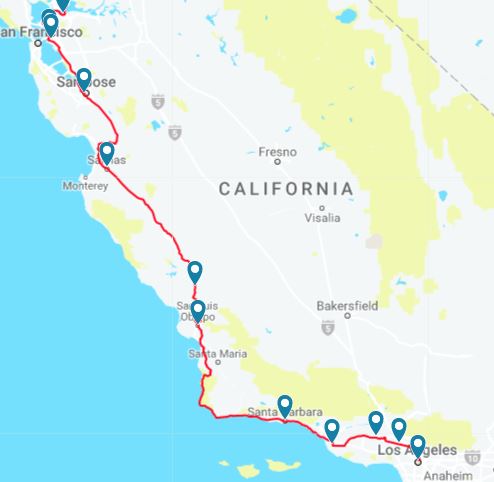
On Wednesday, I traveled 442 miles across the state of California, from Oakland to Van Nuys (just north of Los Angeles). Lasting 10.5 hours, the trip is the longest single train voyage I have taken in my life. Paralleling the California Coast Line, the trip provided stunning scenery as well as moments of deep reflection.
Route of train from the Bay Area to Los Angeles

First, the trip provided some amazing vantage points. Near Monterey, the track ran right alongside the Elkhorn Slough salt marsh.
Elkhorn Slough 
Further south, the train hugged the banks of the Salinas River, and later, the Pacific Coastline.
Along the Salinas River, near Bradley California

Beach near Gaviota, about 32 miles west of Santa Barbara

In San Luis Obispo county, the verdant hillside appeared particularly alluring.


The numerous beaches the train passed that lacked a trace of human activity, the hilly pastures teeming with cattle reminded me just how rugged California is beyond the primary urban cores.

Empty Beaches

Finally, the trip exposed me to the state's underbelly. The derricks of the San Ardo Oil Field (the 8th-largest in the state) had a haunting, monstrous aesthetic, a testament to our society's continued dependency on fossil fuel extraction (even in a "progressive" state).

The California Men's Colony, north of San Luis Obispo, paired authoritarian, rectangular geometry with a suprising openness to the outside world. I could see persons (prisoners?) wandering through the courtyard from the train.

San Ardo Oil Field in operation
California Men's Colony

I stepped onto the platform in Van Nuys with sensations of perplexment and awe.

16th-century Spanish conquistadores conceived of California as a physical island. I believe this metaphor to be quite fitting, when taken in the plural: not a singular island but an archipelago.

Saturday, January 21, 2017

Trump the Caudillo and the Latin American-ization of US Politics

Top: Juan Peron, two-term president of Argentina     Bottom: Donald Trump


Donald Trump's authoritarian, demagogue-like tendencies frequently merit comparison to Hitler and Mussolini. On the morning after Il Orange entered the Oval Office, a search for "fascism" turned up about 285,000 listings on Google News, with the vast majority of results (on the first three pages) pertaining to the Cheato.  Unfortunately, the gross, genocidal excesses of both the fascist and Nazi regimes make these comparison a bit ineffective in my opinion (as long as he does not start a World War and commit mass murder of ethnic minorities, Trump will be "okay"). A more effective (and recent) parallel may be drawn to the Caudillos, or populist strongmen, of Latin America.

Often (but not always) emerging from the military, and including leaders as diverse as Augusto Pinochet, Juan Peron and, disputedly, Hugo Chavez, the Caudillo rises to power through brash appeal to the disaffected working classes. Once he takes control (sometimes through military coup but often through popular vote) the Caudillo dilutes or abolishes the legislative checks on his executive power (e.g. amending the constitution to run for additional terms or evicting the press from the Oval Office), without actually upending with the democratic system or its institutions of governance. When the political establishment cries foul, the Caudillo declares that he is "under attack" by the ruling (e.g. beltway) elites, thereby rallying support from disaffected segments of the lower or middle classes.

Furthermore, an essential component of a Caudillo's appeal (particularly for right-leaning ones) is the projection of masculine dominance--the image of the "macho" man who can get things done (and have his way with woman).

What is particularly striking about the comparison of Donald Trump and Latin American strongmen are the similar political contexts which have birthed them. Latin American countries are among the few in the world that share the United State's presidential form of democracy, where the executive branch is chosen independently from the legislative branch. In contrast to the form of parliamentary democracy dominant in Europe, the executive in a presidential republic does not leave office if an opposing gains control of the legislature. And yet, presidential republics naturally subject the executive's law-making authority to the legislature's approval as part of the system of checks-and-balances. Therefore, when the branches of government are divided, especially between ideologically-opposed parties, gridlock is the most likely outcome.

Since the president's derives his legitimacy independently from the legislature, arbitrary executive authority provides a convenient tool to break inaction, one that--unfortunately--subverts the legislative checks crucial to democracy's survival.


For a long time the American President did not need to override Congress because members of both parties could compromise to enact legislation with a broad centrist appeal. The ideological polarization of recent decades has changed this. Presidents Bush and Obama both came to rely on executive mandate. God only knows how Trump might wield his power on immigration policy or trade.

In Latin American countries, by contrast, the legacies of a colonial caste system have long produced sharp division between white criollo landowners and a mixed-race and indigenous laboring class. Thus presidential democracy has been tested from an early age by a combination of class- and race-based polarization (often augmented by geography), which has only afflicted the US political system for the last 50 years.

(Of course, the US political system largely muted racial divisions for much of its history by actively excluding the colored working classes from political participation. My argument is that such polarization did not previously manifest itself in politics, not that it did not previously exist).  

With sharp polarization, partisans on one side will believe the worst of the opposing party (even ludicrous mistruths). When their party secures the presidency, they will support any executive initiative to overcome opposition in the legislature (especially by a minority party). If their party controls the legislature (but not the presidency) they will demand obstruction of governance, to the point of a breakdown (or unilateral action).

Such contempt for minority rights (or, alternatively phrased, support for authoritarianism) is especially evident among classes that feel like their position of privilege is threatened.

Will Trump use the slightest threat to declare a state of emergency (with the military by his side)? Will he simply work to perpetuate GOP rule by appointing justices who strike down the remainder of our voting rights protections? Or will he alter libel laws so that he can stifle critical media coverage with lawsuits?

The future is uncertain, terrifyingly so.

Our country is not exceptional (i.e. destined to be a liberally democratic). The historical moment is not normal.

For the next four years, we must never let down our guard.

We must always resist.

Saturday, December 31, 2016

2016: What were you and where am I?

As the New Year approaches, I am at a bit of a loss for words.

Partly, I have been experiencing a bit of burnout the past few weeks after a 10-week quarter in which I wrote more than 50 pages worth of analytical material on planning history and theory and transportation policy.  

Even more broadly, 2016 has been an exceptionally surreal year, punctuated by unexpected and cataclysmic events that have been difficult to explain or to minimize out of my daily routine of existence.

The election of Donald Trump, the "Brexit" referendum results, the sabotage of the American election by Russian spies. Just like the string of celebrity deaths in the past week, these events numb one with shock (Listening to Obama's and Hillary's speeches in the back of an Uber on the morning of November 9th came the closest I have felt to living a hallucination).

But since my future career (as a Transportation planning and policy student) entails working with or on behalf of local governments the great "political" events or very much personal. If the Trump administration cuts off federal support for public transportation (and redirects such funding towards private toll roads) or strangles LA's wholesale sector by imposing tariffs, then not only will my job opportunities but the ideals I aspire towards in my career suffer a set back.  

Once upon a time, I shunned "Identity Politics" and though that racism did not affect me. I have evolved  a great deal since then, but until this November I did not feel as if my personal existence, as an American with Chinese ancestry, was threatened. Watching a middle-aged white male yell at an Asian undergrad to "go back to your own country," in the middle of my campus's Court of Sciences, shattered my blissful contentedness.

Sharing an Uber (back in March, believe it or not!) with a young man who complained about "Islam" and "cuck-servatism". Consoling a teary-eyed stranger in an Uber on election night.                          

Even watching the cities I had visited in Europe a few years back suffer both jihadi terrorist attacks and far right political rallies sent shivers up me.

For all the catastrophes that have shaped the world around me, however, I have been fortunate to have made good friends a part of my return to school. I have also managed to reconnect with a number of people from my undergrad days and earlier (particularly through the Olive Tree Initiative). It is in times like these that these personal connections matter most.

This is also the year that I first felt "old" in more than a relative sense. A few crazy nights back in February (which resulted in me getting a fever) revealed a liver that lacked its youthful pep. Having lost my uncle and a close friend in the previous year, I have given a lot more thought to my mortality. I officially reached a quarter century in age.

Time does not stand still but it does not necessarily progress or retreat.

That is my story of 2016.


Tuesday, August 16, 2016

Los Angeles: The Beautiful and the Ugly

It dawned on me this past May as I rode phase 2 of the Expo Line for the first time, over the bridge above Sepulveda Blvd. It was the very thought that would come to me frequently as I drove north on the 405 from the airport to UCLA, or that one time when I stood  on top of the Baldwin Hills Overlook....  I would peer out the side window, or over the dashboard, and catch sight of the Wilshire Corridor's skyscrapers arrayed against the parched Santa Monica Mountains, perhaps (at the overlook) also peering over boxy retail and commercial buildings and single-family homes in the foreground. The interjection of untamed nature among thick swathes of (bland) modernist development, and the erection of a concrete human presence in semi-arid steppeland have both exasperated and intrigued me...

Mid-century modernism ringed by sun-baked mountains and irrigated greenery

What these experiences have reminded me is that Los Angeles is simultaneously "beautiful", embodying many of the good qualities of cities, and "ugly", embodying many of the bad. As has been true from time immemorial (e.g. sunshine and noir), the city's positives and negatives interact more through means of paradox than juxtaposition.

Take for instance, the pristine nature, such as that I observed in the mountain views. Few other American cities (in fact, Portland, is the only other city that immediately comes to mind) have such expansive tracts of wilderness as the Santa Monica Mountains, Griffth Park and Runyon Canyon in such close proximity to the urban core. Mountain Lions and Coyotes scamper across the region's busy freeways, and hide behind apartment buildings in dense neighborhoods like Westlake. And yet, Los Angeles is notorious for its paucity of traditional urban "green space." Not only does LA have the fewest parks per square mile of any major American city, but (outside of Downtown), the parks it has do not provide the sort of social gathering space found in European or Eastern cities.

As if to compound the problems of deficient open space, Los Angeles is dense. The metropolitan area as a whole is the densest in the country, while, as of the year 20101, the city's planning sub-areas ranged in population density (measured in persons per square mile) from a figure just above Portland's (for West Los Angeles) to a figure almost equal to San Francisco's (South Los Angeles). With people of every race, color and creed jammed together into duplexes and townhouses from Encino to San Pedro, the region should be an urbanist's dream.

Nature, Los Angeles-style

Unfortunately, Greater Los Angeles' density is (for the most part) haphazardly dispersed rather than centrally-concentrated, justifying the region's reputation for "sprawl".  20-mile to 30-mile long swaths of the San Fernando, San Bernadino and San Gabriel Valleys are blanketed by a morass of dingbats and pre-fabricated apartment buildings: with millions commuting between each of these valleys and the coastal business centers or office parks further inland (along geographically-constricted corridors), the end result is notorious congestion. The prevalence of car-centered strip mall commercial corridors in "urban" Koreatown as much as in "suburban" Covina adds to the all-around blight and congestion.  You can get the two-story suburban house with a backyard and (maybe) a pool, or the compact two-bedroom apartment: but the former does not offer tranquil seclusion and the latter lacks vibrant architecture or public space. Instead, urban life manifests in jam-packed highways...and smog.  

And then there's walking. An 80s-pop song reminds New Yorkers that "Nobody walks in LA" but this is far from the truth. Indeed, perhaps no other city in America ritualizes walking as much as LA does. From 7am to 8am and 5pm to 7pm each weekday, an army of joggers and dogwalkers fans out across the sidewalks of every single-family residential zoned neighborhood in the region. Like clockwork, the pedestrian legion dissipates at the end of the timeframe almost as quickly as it appears (though activity is somewhat more constant at some of the Regional Parks, e.g. Runyon Canyon). Outside of some isolated tourist hotspots (e.g. Hollywood, downtown Beverly Hills), nobody walks in LA to get places but everybody does their daily "walk" for a healthy heart and lower cholesteral.

To be more accurate, the above applies to middle and upper-class Angelenos (the cohort which I live among). The places in LA that boast the most throngs of pedestrians are the lower-income, predominantly Latino and Asian neighborhoods that ring Downtown. Stand for a few minutes at the corner of Western Avenue and 6th Street in Koreatown or Alvarado and 7th Street in Westlake and you can easily fool yourself into thinking you are in Manhattan (for the former) or Mexico City (for the latter). Supporting the pedestrian throngs are a cohort of street vendors, one of the largest in the Western Hemisphere (who are kept a safe distance from bourgeois districts, due to city ordinances that officially "outlaw" such activity). Los Angeles is one of the few major cities in the world in which the liveliest neighborhoods tend to be the most impoverished.

That being said, the gentrification of Downtown's Historic Core changes the picture a little, though I see that area as more of a hipster Hollywood (predominantly a nightlife destination) than a genuinely walkable neighborhood. Spring Street now even has a dog park...

A lack of public space and human interaction, as well as a vast physical geography, cause (middle- to upper-class) Los Angeles residents to suffer from personal isolation to an extent unknown in any other world city. If you have your circle of friends from college, you'll make the weekly drive to cling together. If not, then good luck (You're as likely to run into a tourist from Shanghai or Dusseldorf as you are a resident from the neighboring apartment block, when frequenting the Grove). Visitors from the East Coast and Europe are always impressed by the outward "friendliness" of our residents--especially those who work in restaurants or coffee shops. Little do they remember that many of us are professional actors, who do their best to conceal how much all of us suffer.  

And finally, there's the human diversity. I once encountered a statistic stating that the students of the Los Angeles Unified School District speak 120-something languages at home. From personal experience, I can attest that the LA area is one of the few in the country (if not the world) which boasts eateries featuring almost every cuisine imaginable (see my new food blog for more on this). And yet, thanks to the lack of public space and communal interaction, Los Angeles' diversity results more in atomization than cross-pollination. Jane Jacobs famously remarked on a Los Angeles resident who had "never laid eyes on a Mexican"2, despite its significant Mexican population. I myself never ate at a taco at one of the city's iconic loncheras until I started venturing to the Eastside as a Lyft driver after college. As food critic Jonathan Gold once said, in Los Angeles the (different) ethnic groups "cook for themselves" and not for one another or the city as a whole. Such an attitude contributes to the city in raw variety and authenticity, but deprives the city of social cohesion, personal enrichment (for its individual citizens) and a unique sense of place.

 Having recently left the city for a week-long vacation, I understand how much I love LA. The vast expanse of urbanity, the variety of people and places, the mountain vistas and ocean sunsets, the taco trucks and loncheras... Each of these qualities is intertwined with such social ills as sprawl, traffic, or conflict. It is true that Los Angeles has long-lacked in quality long-term city planning, though maybe Los Angeles is too complex or too "real". to reduce to a perfected form. Regardless of whether I can live to see that ideal implemented, I can ponder a better future while cherishing the present.


1. Based on calculations I made as part of a project for work, in June.  
2. Jacobs, Jane. The Life and Death of Great American Cities, pg. 72.