Sunday, September 29, 2019

Cough Syrup: The song of the decade?

Last night, I listened to Young the Giant's Cough Syrup for the first time in a while. The song elicited feelings of nostalgia (I listened frequently when I was in college) and, at one point, I had an epiphany: this song, written in 2011, foresaw much of the global and (at the, level of society) personal debacle of the decade that was to follow. The song speaks to the combination of political turmoil (precluding any guarantee of social longevity) and widespread addiction to (and fixation on) social media that have infected/bedeviled the American Millenial.

Life's too short for Cough Syrup now, oh oh. 
I'm losing my mind, losing my mind losing control oh oh, oh oh. 

Like the lead singer, we have increasingly lost focus in the past ten years, both in the literal and figurative senses. Our attention spans have diminished, to the length of 150 words or a two-minute video. Our reasoning capacities have shifted away from structured arguments (even if rooted in fallacies or personal biases) to snappy phrases and images that appeal to sensation rather than logic.


If I could find a way to see this straight, I'd run away
To some fortune that I, I should have found by now
I'm waiting for this cough syrup to come down, come down
And so I run to the things they said could restore me
Restore life the way it should be
I'm waiting for this cough syrup to come down
Bloody Marys under neon-lit Palm Trees. Beachside "vacays" or "staycays" tinted with a retro b-and-white "filter". Escapist fantasies, reified through a polished online presentation, become the "soma" (in Huxleyian terms) of the masses in an age of rising sea-levels and resurgent fascism. Not to mention the fact that many are literally drugged on opium. 
These zombies in the park they're looking for my heart oh oh oh 
A dark world aches for a splash of the sun oh oh

Repeat: resurgent fascism. Data theft. A mass state of conspiracy.
And so I run to the things they said could restore me
Restore life the way it should be
I'm waiting for this cough syrup to come down
Repeat: Escapism
One more spoon of cough syrup now whoa


Saturday, September 28, 2019

Air Fares to Europe: Why the Low Prices?

I spent much of last month in Europe. Over the course of 19 days (from August 8 to the 26), I schmoozed, sipped and sight-seed my way across Spain, Germany (Berlin) and the United Kingdom.

Although exhausting, my travels were incredibly rewarding both in terms of leisure and learning. Adding to the trip's value was the surprising affordability (given the distance traveled). My round-trip nonstop tickets on Iberia to and from Madrid (the starting and ending point for my travels) only cost me 390-dollars.

That's right. 390 dollars, a price within 100 dollars of the price one typically pays to fly to the East Coast in the same season.

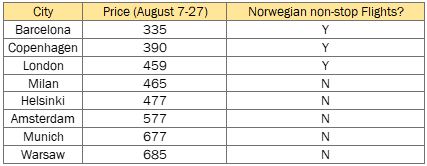
One may think that I encountered an incredibly good stroke of luck (e.g. a last-minute cancellation). But the research I conducted beforehand indicated that my flight was no fluke. When I first researched flights at the beginning of March, round-trip tickets to Barcelona with the same dates were going for only $335 apiece. Multi-city tickets (see Table 2), involving flights into Barcelona at one end, and out of Copenhagen or London at the other end cost only $390 and $459, respectively.

The last time I visited continental Europe, back at the tail-end of the Great Recession, I had to dole out $1,350 for my airfare, with a stop on the way back. What happened?

One of the big break-throughs in transatlantic air travel since my previous visit to Europe has been Norwegian airline's inauguration of low-cost long-haul flights. Using a complex system of contract labor and segmenting responsibilities among various corporate subsidiaries (based in countries with loose regulatory regimes), the airline has cut costs to the point where it can sell non-stop flights from LA to several European cities (Table 1) for as little as $380.

Table 1.Cost of Round-trip Non-stop Flights on Norwegian Airlines from Los Angeles to European Destinations


Interestingly, the three bargain origin-destination pairs I discovered in March (i.e. Barcelona-Barcelona, Barcelona-London and Barcelona-Copenhagen) incorporated cities with non-stop, year-round Norwegian service on both ends (Table 2). By contrast, when I looked at returning from cities which lacked non-stop Norwegian service (maintaining Barcelona as the point of entry) I found the round-trip fares considerably more expensive: returning from Amsterdam or Munich increased the flight cost to nearly $600 or 700$, respectively (Table 2).

Table 2. Comparison of Flight Costs to cities with and without Norwegian Service for the dates August 8-27, 2019


Could it be that Norwegian was driving down fares through its competitive pricing?

To tackle this question in depth, I compared airfares from Los Angeles to several European cities for the dates of April 8-15, 2020 (see Table 3). Four of the cities have Norwegian service and four do not. Cities were selected so that each city with Norwegian service was located in the same general geographic region of Europe as a city without Norwegian service. This would control for the influence of geographic factors on air pricing trends. I limited the analysis to cities that I knew to be major air travel hubs (all of the cities' primary airports rank among the 20 busiest in Europe-and are thus less susceptible to influence by a particular airline cutting or adding service) and that had non-stop service from Los Angeles.

Table 3. Comparison of Flight Costs for Week of April 8 to 15 for Destinations with and without Norwegian Service


Across all four regions, cities with Norwegian service had a lower-priced roundtrip ticket than cities without Norwegian service (with the absolute price difference ranging from $29 to $222).  Indeed, performing a Student's T-Test on the average price difference for the sampled dates, shows that there is only a two percent probability that the average price for cities with Norwegian service is equal to or greater than the average price for cities without Norwegian service (Table 4). At a 95 percent confidence interval (as is standard in statistics), the difference between the average prices is statistically "significant." In other words, there is substantial enough variation for the sampled dates to conclude that the actual mean price for flights to and from cities with Norwegian service is lower than the actual mean price for cities without Norwegian service.

Table 4. Student's T-Test, Norwegian and Non-Norwegian Cities


Wonkiness aside, this finding has important implications for air travel and urban economics. It provides yet further evidence that the entry of low-cost airlines into a market drives down the price of flying into that market for all consumers (regardless of whether they actually fly on the airline). It suggests that the price of a flight has as much to do with competition as with the actual inputs (primarily jet fuel) of travel (flying from LA to Dublin involves slightly less fuel expenditure than flying from LA to London, yet costs more because the market is more constrained). Indeed, flights from Los Angeles to several mid-sized destinations in the eastern US, including Charlotte, NC and Albany, NY, were priced within $100 of the flights to the Norwegian destinations in Europe.

Urban and Regional Economics has recently taken an interest in the divergence between America's "superstar," knowledge-economy cities along the coasts and struggling blue-collar cities in the Rust Belt. Many factors beyond the scope of this paper could account for these disparities, but the pricing of access from the coast to the heartland at levels equal to or higher than access from the coast to Europe certainly impedes the ability of residents in the latter cities to connect with the human capital and resources of the latter. Therefore, these findings raise important questions regarding how air connections impact the development of "city-systems" both nationally and internationally.


Sunday, September 1, 2019

September-The end of my writing vacation

As the summer season bids farewell
but temperatures stay high as hell
The poolside party turns mundane
Siestas like the south of Spain

Why slumber when you're young and free
And all that's yonder you can see.
With fresh eyes and ears,
Challenging and awakening,
Ideas gesticulating
Dogmas vanquishing

My thoughts,
a multitude of stories
and commentaries
each provocative
and eloquent
(in some way)
Will disappear
unless I record them
on paper

So I, enthusiastically,
write articles and poetry
for all the world to see
to listen and learn and grow
with me


Saturday, March 30, 2019

Nationalize (private) higher education

Last week's college admissions scandal, in which a number of rich and famous persons were convicted of paying bribes for test scores and athletic recommendations, came as little surprise to informed commentators. For years, elite private universities have privileged the progeny of the 1 percent in admissions through so-called "legacy preferences" which give an assist to the children of alumni as an incentive for alumni donations. Such favoritism not only rewards a demographic that is much wealthier and whiter than the general college-aged population but encourages "pay-to-play" contributions, in which generous donations by alumni billionaires are rewarded in kind by a child's admission.

In the words of education scholar Richard Kahlenberg, legacy preferences are nothing more than "affirmative action for the rich." As a policy that rewards money over (even the pretense of) merit, legacy preferences are grossly unfair and unjust.

And yet, despite coming under attack from voices across the political spectrum, colleges have made clear that legacy preferences are unlikely to go away anytime soon. The reason is simple: many private colleges (with the exception of scientific research institutions, like MIT and Caltech) rely on alumni donations for long-term financial stability.

As long as private universities remain private, untethered from permanent public support (or accountability), they'll have every incentive to indulge in a form of admissions apartheid, that they perceive to fulfill their bottom line.

Therefore, ending legacy preferences, and other preferences for the wealthy elite in university admissions may ultimately may require a more far-reaching policy: nationalization of private universities by the federal government.

Under government control, universities would gain a reliable funding source that would obviate universities' donations-driven groveling at the whimsy of wealthy alumni. As public institutions, the universities would likely receive greater scrutiny for employing policies that reward an inheritance (linked with privilege) over merit or need.

Nationalizing private universities would also make it easier for the federal government to implement the tuition-free higher education policies that have become the darling of Democratic presidential candidates. Acquiring control over some of the wealthiest non-profit endowments on the planet could provide a steady funding stream to offset a reduction in tuition revenue. Furthermore, both the government and universities would not need to bear the (monetary and transaction) costs of hiring "middlemen" to administer a government-funded tuition program.

I propose a takeover of private universities by the federal government, rather than the states (which currently manage public higher education), because only the former could achieve such a feat in a one-off event. A state-by-state process would require the buy-in of 27 Republican governors, loath to undertake any policy that smacks of socialism. Moreover, a federal takeover would produce the first national public university system in the country's history, eliminating current geographic disparities in students' access to higher education. While some state colleges (e.g. the UC and UofM systems) have a status comparable to the Ivy League, many fall far below the elite universities in terms of educational quality and research opportunities. Since most state colleges only offer reduced tuition to students from within the state, access to affordable, quality education is currently a lottery based on one's residence. A national university system, with subsidized or free tuition, would do away with this arbitrary stratification.

Finally, and less tangibly, nationalized higher education would diminish any prestige dividends perceived from private college attendance. Wealthier parents in the know could have less incentive to use their money and networks to finagle their kids' entry into "Ivy League" or "Ivy Plus" schools,

Just as the United States is an outlier (among the industrial economies) when it comes to the cost of higher education, its an outlier in terms of its extensive private education structure (even foreign universities as prestigious as Oxford are public). Progress on the latter front can lead to progress on the former, while reducing class and race-based segregation.

Sunday, March 17, 2019

Asian-Americans: the Glaring Omission in Progressive Politics

Politicos on both the left and the right have traditionally assumed that middle-class Asian-Americans boast a status akin to whiteness.

While right-wing billionaires sue Harvard on the grounds that affirmative-action programs for disadvantaged minorities discriminate against both asians and whites, many left-wing publications ignore asian-americans altogether when discussing issues of racial justice. Those that do frequently note the diversity of the "AAPI" (Asian-American Pacific Islander) community, separating "privileged" middle-class demographics, like Chinese-, Japanese- and Indian-Americans from working-class Filipino- and Vietnamese-Americans.

However, although middle-class East Asians tend to enjoy incomes comparable to or higher than the white majority, they experience subtle but pernicious discrimination in the social and cultural spheres of American life.

Asian-Americans of all stripes are under-represented in film, cable and broadcast TV, comprising as few as 3 percent of film roles and 2.5 percent of cable Television roles in 2016. Those Asians that do manifest on the Silver Screen tend to be shown as either crafty foreigners, sexually-incompetent dweebs or a combination of both (look no further than the Hangover's Mr. Chow).

Asian-American youth are the demographic most likely to be bullied in school. Asian-American adults are the least likely to be promoted to corporate management positions (despite being over-represented in the professional fields). And Asian-American males are the least-likely to "match" with a partner on both gay- and straight- dating websites.

The last fact hits particularly close to home. I have spent days at a time on Tinder "swiping" right (on profiles of all races) without getting a single match. The infrequency with which I match on Tinder or Bumble heightens the stakes for each match I do get, so that my anxiety acts up when I finally land a date. My lack of success in online dating, has caused tremendous personal frustration in the last 5 years.

All of these forms of racism speak to an enduring typecast of Asian-Americans as effeminate foreigners, who are good at math but poor at people-skills, leadership, decisiveness and other traits that define the heterosexual "man's-man". While stereotypes about African-Americans and Jews (though still pervasive) must at least be coded for utterance in polite society, jokes about Asian's "tiny dongs" and accounting skills get a pass in the (ostensibly-) most progressive corners of America.

Despite embracing an attitude of #resistance to the Trump presidency, many progressives have showed ignorance or indifference to the revelation of Harvard's racist "personality" rankings of Asian-Americans (which admittedly came about as part of a lawsuit that had a reactionary agenda, but still...). The Democratic Party's minority outreach efforts ahead of the 2018 midterm election focused primarily on Latino voters, despite the fact that Asian-Americans are a principal demographic in the suburban swing districts crucial to Democrats' success. To date, I can find no example of a progressive policy focused explicitly on the concerns of the Asian-American community.

Indeed, rather than confront Trump's racially-coded China-bashing, the Democratic party's most liberal politicians have-in many instances-piled on. Even if the protectionist tarriffs Democrats propose are primarily economic in focus, they lend credence to an agenda that is as much about nationalism as about restoring trade deficits.

Although Trump has (with a couple exceptions) avoided overt racial animus towards Asians until now, his record on race indicates that he is more than capable of stirring up anti-Chinese, if not anti-Asian sentiment, say, if a crisis erupts with a China or if his poll numbers falter.

Can progressives be counted on to defend the rights of Asian-Americans, as participants in the American social contract rather than as foreigners deserving mere "respect", when the time arises?

I would hope so. But the evidence so far suggests otherwise.

Sunday, March 3, 2019

Bojack Horseman Review

I finally caught up with the Bojack Horseman craze last night when I watched the first episode of season 1 (courtesy of my free Netflix subscription, that's right!). I had heard many positive reviews from friends and other acquaintances, so I began watching with eager eyes. The episode began in an uneven fashion but held out hope at the end for a more promising trajectory. 

At first glance, Bojack Horseman comes across as Family Guy 2.0, updated for 2010s hipster sensibility. There's the loutish, alcoholic middle-aged slacker (in this case, a celebrity horse, who had a TV show in the 90s). There are anthropomorphic animals (of course, more of them and more central to the plot). And there are the ubiquitous flashbacks to events that explain a particular reference or suit his/her whimsy. 

The subtext is more serious, however. Bojack needs to get his novel out to fulfill terms of indenture (a flailing penguin publishers--run by actual penguins). Lacking self-discipline, he can't. HIs part-time girlfriend/agent breaks up with him, after a contentious date.

The animals, the sex/drugs and the level drama almost make it feel like one giant effort at irony.  Look guys (my imaginary studio exec would say): its Charlie Sheen he's a horse (almost in "War Horse"), he barfs cotton candy and has a publishing contract. Won't that crack up the youngster's in Williamsburg? 

Halfway through, Bojack was trying too hard and not making me laugh. 

Fortunately, the repetitiveness of the gags (e.g. the party requests, Peanut Butter crossover jokes) made me a laugh after a little while. Some playful absurdity at work. Nice! 

I'll be watching seasons 2 or 3 and getting back afterwards. 

Saturday, August 18, 2018

A rant on "real-time" transit scheduling

I'm mad as hell...

at the love of my life

and I'm not going to take this anymore.
 My feelings toward...

the love of my life
__________________________

Picture this: You break your neck to take the 6:00PM bus from your work in Monterey Park to Downtown LA, to connect to a 6:20 bus that (Google Maps' transit directions say) will get you to your grandparents house right on time for a 7:05 dinner. The first bus arrives a few minutes behind schedule (given by Google Maps), but still gets you to Downtown with 5 minutes to spare. You run up the gently-sloping hill to the stop where you catch the second bus (1 minute). Then you wait 10 minutes: no bus comes.

Its 6:26 now. You take out your smartphone and ping GoogleMaps. From "your location" to my grandparents' address, the app now shows a bus that leaves at 6:38. "You couldn't have missed the 6:20!" your conscience yells. There were two other guys here who say they waited for 5 minutes before (though, did they actually keep track?). Still, its only another 10 minutes, the brain reasons: you take a deep inhale, sigh and return to playing free computer chess.

You lose yourself in plotting some crafty chess moves, eventually taking down a queen and a knight. At some point during the game, you press the home button on your phone by mistake and see that it is 6:50. Suddenly remembering that you are en route to dinner, and not a pawn in a game, you open up Google Maps again. This time, the transit directions instruct you to walk 1 mile to the south to catch a bus that will take 12 minutes longer to deliver you to your grandparents. You are stunned to see that you will not arrive until 8pm. You would miss dinner.

The new calculation throws you into a frenzy. You can order a Lyft Line or Uber Pool and maybe get to your grandparents only 30 minutes late. And yet, you are at a bus stop: what if the bus due at 6:38 miraculously appears a minute after you make your request, which you can't cancel without incurring a $5 penalty. Is a 50 percent or lower chance of saving time worth $11 extra? Your family is more forgiving of delay than, say, your boss, so you continue to wait...

After another 4 minutes, give or take, two buses show up. You board the latter one. Riding in light traffic, the bus drops you off 2 blocks from your grandparent's door at 7:30.

______________________________

I experienced this saga twice last Friday, first on the evening commute from work (as narrated) and later on a trip to the bar (the latter trip did not involve a transfer).

Although the delay was longer than usual, this was not the first time that a Google Maps transit schedule has deceived me. On most of my transit journeys in the Los Angeles region, in fact, Google's transit departure and arrival times seem to follow the official schedules, with buses arriving a few minutes before or after the time given on the application.

Even if such variability does not always cause excessive delay, it forces transit riders to leave extra time for contingencies (e.g. arriving at the bus stop 10 minutes ahead of Google's scheduled times) and diminishes their perceived agency over their trip schedule. By contrast, drivers benefit from real-time traffic information and point-to-point travel. Thus, driving (already privileged by roadway engineering, subsidized infrastructure, etc.) gains even more of an advantage over transit in Los Angeles, and transit riders ditch their straps for steering wheels once they acquire the resources.

Given that automobiles are the greatest source of Greenhouse Gas Emissions in the state of California, transit's inability to offer riders the accurate, real-time information offered to drivers fails not only transit enterprises, but society. 

Why does Google Maps' transit planner (the most comprehensive transit planning application in terms of regional and national coverage) fail so miserably at providing accurate schedules for LA-area agencies? Is there a structural flaw in the GTFS specification? Does blame lie with the agencies or with Google (or both?)? I am interested in learning more about this problem and engaging with potential solutions.